
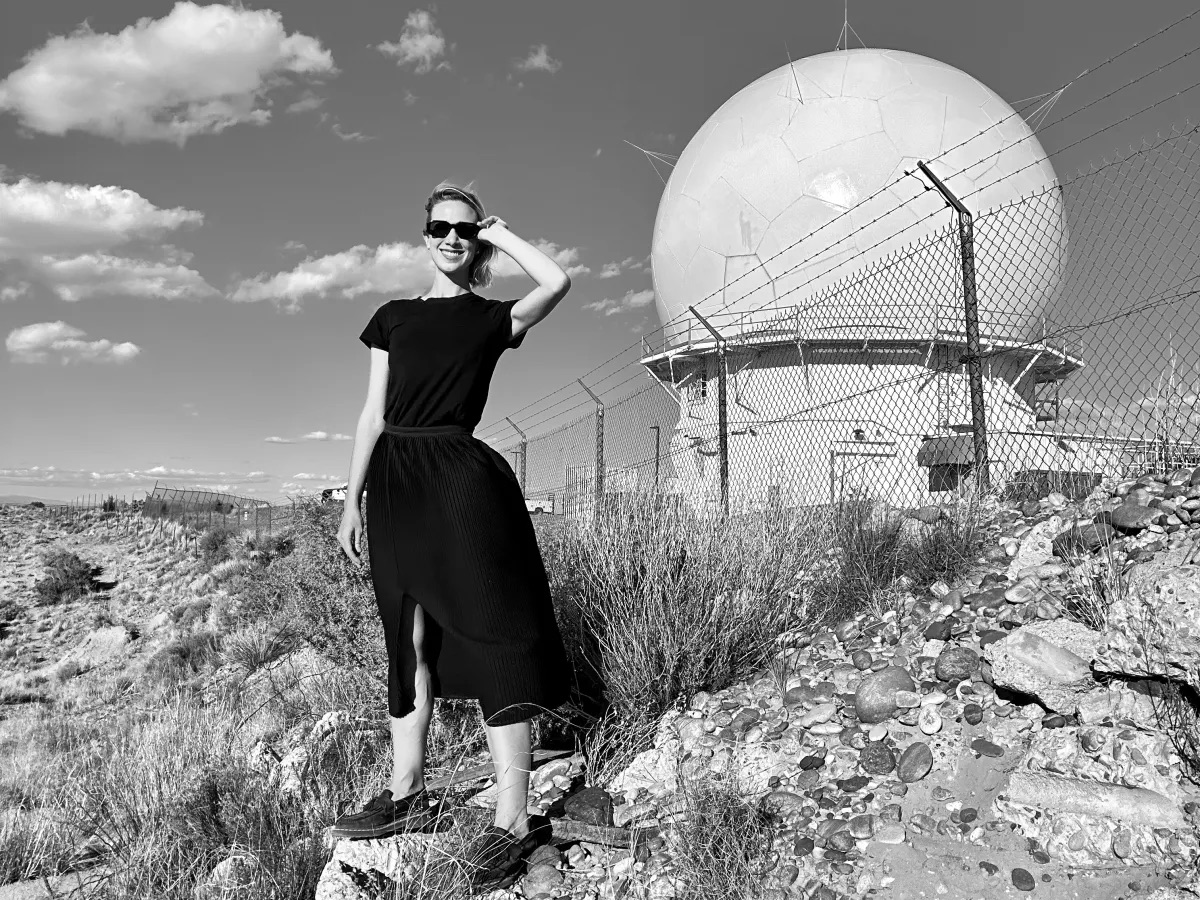
Can you tell us about Nina? What do you do for a living, where do you live, and what’s your lifestyle like?
My name is Nina Ellis, and I’m a writer of short fiction and the first biographer of the short story writer Lucia Berlin. I teach English & Comparative Literature at the American University in Cairo, as an Assistant Professor, and I live in a neighborhood on the eastern bank of the Nile with my husband and our one-year-old son.
Although I’m British-American, I have lived a peripatetic life: I grew up in Paris, and my husband and I lived together in Islamabad before moving to Cairo. I have also lived in London, New York, Cambridge and Princeton, and I was born in Dallas, Texas. I’m an in-between person, and I see this as a huge privilege: what could be more fun than getting to travel the world?
You’re now teaching in Cairo, writing about an American writer deeply shaped by Latin America. Does this seem complicated? How do you handle it?
Lucia Berlin was one of the most important short story writers of the twentieth century, but she sadly did not achieve a wide readership until a decade after she died in 2004. And her writing was not the only exceptional thing about her: she also lived an exceptional (and exceptionally transient) life, which shaped her fiction: she was born in Alaska, but she lived all over the United States, Chile and Mexico, moving frequently.
I’ve tried to capture this journey in my biography, Looking for Lucia: A Biography in Motion, by retracing Berlin’s footsteps across two continents, and interweaving the story of my literary road trip with my account of her extraordinary life. Looking for Lucia will be published in 2027, and you can stay up to date on that by signing up to my Substack newsletter.
Perhaps it seems incongruous that I finished writing a book about someone whose life and work was so deeply shaped by the Americas while living in Egypt — but there are many more connections between the Middle East and Latin America than we might initially assume. Tahia Abdel Nasser has written a wonderful book about this called Latin American and Arab Literature: Transcontinental Exchanges, which I highly recommend.
That said, it was coincidence that I ended up in Egypt, and that this is where I’ve completed my work on Looking for Lucia: it was simply where my husband and I happened to get jobs, which was lucky, because we love it here.
Cairo is a city with an enormous literary culture of its own. Has living there changed what you write about, or how?
Yes, absolutely. Living in Cairo has opened up a whole wonderful world of Egyptian writing to me, some of it in translation (as I’m still learning Arabic) and some originally in English. For instance, I hugely admire the fiction of Ahdaf Soueif, and it was such an honor to get to invite her to the AUC to speak to my students last month. She was very generous with her writing advice and insights, and so charming! We were all star-struck, especially me.
Other Egyptian writers I admire include Noor Naga, whose short stories I teach in my Creative Writing courses as models for how to incorporate Arabic language and culture into primarily English-language writing — I really appreciate this multilingualism, and my students, who are mostly bi- or trilingual themselves, seem to find it liberating, too. I’ve just finished Iman Mersal’s creative nonfiction book Traces of Enayat, in its English translation, which is an ingenious reworking of the biographical form, and also a gorgeous portrait of Cairo as a city. I loved it. And finally, one student recently introduced me to the short stories of Alifa Rifaat, which are absolutely brilliant and criminally under-read. Rifaat died in 1996, and published mostly during the 1980s, in Arabic. I exhort you all to track down her book Distant View of a Minaret and Other Stories, which was translated into English and is now out of print, but is still available second-hand, online. It is one of the most gripping and moving short story collections I have ever read.

Having lived in Texas, France, the UK, and now Egypt, how does this “betweenness” influence the voices of your characters?
All of my short stories are narrated by “in-between” characters, even when their backgrounds are quite different to my own. It seems to me that “in-between” position gives us a particularly sharp view of the worlds to which we are simultaneously insiders and outsiders. Sometimes my characters are geographically “in-between”, as in ‘New Territories’ and ‘The Kingdom of the Shades’, and sometimes they are socioeconomically “in-between”, as in ‘Georgia O’Keeffe and the Angel of Death’ and ‘Our Agent at Dawn’: socioeconomic mobility is another type of transience that I have experienced, both upwards and downwards.
As someone who doesn’t belong anywhere in particular, I hope that I am able to engage with my surroundings without taking anything for granted, because everything remains at least a little bit unfamiliar to me, however long I live somewhere. And in the meantime, living in cities for years at a time grants me access to spaces and relationships that wouldn’t be available, for instance, to a tourist.
Still, I should emphasize that I will never achieve the depth of insight that, say, a native Cairene is develops over the course of their life in this city. I simply write what I know, which is what it means to occupy liminal spaces, and to be always in motion.
As someone who has lived in many cities across world, which place had the greatest impact on you?
This is a difficult question, because they have all had an impact on me. Growing up as an immigrant in Paris, speaking French at school and English at home, taught me the value of multilingualism. My undergraduate and doctoral degrees at Cambridge made me a scholar, and taught me how to read texts analytically, particularly through my studies with Professor Kasia Boddy. Working in Manhattan taught me how the literary industry works: it demystified it for me and gave me the confidence to start writing seriously myself. Islamabad was a revelation of the impact and legacy of colonialism, of course, but also of how much I didn’t (and still don’t) know of the world beyond Europe — and it’s where I first lived with the man who is now my husband, so it will always occupy a special place in my heart. And finally, London was my education — particularly Tower Hamlets, where I spent five years as an English teacher in a state secondary school and discovered my own passion for literature.
Do you consider yourself a keen reader? Are there any books that have “changed your life”?
Definitely — so many! Of course, the posthumous collection of Lucia Berlin’s short stories, A Manual for Cleaning Women, has had the most tangible impact on my life, in that it led to my PhD on Berlin, a decade of research and writing on her work, my book deal with Farrar, Straus & Giroux for Looking for Lucia, and many wonderful friendships and conversations with Berlin’s relatives and friends.
The most important texts to my literary education are mostly British and American, because of the circumstances of my upbringing, although they often also focus on “in-between” perspectives — for instance, I adored reading Shakespeare at school, and identified deeply with Horatio, Hamlet’s best friend (and indeed that is our son’s middle name). Other books that shaped me include Jean Rhys’s Good Morning, Midnight, Joanne Kyger’s Strange Big Moon, Andrea Lee’s Interesting Women, Mary Wortley Montagu’s Turkish Embassy Letters, all of Lydia Davis’s short stories, Saidiya Hartman’s ‘Venus in Two Acts’, Frank O’Hara’s Lunch Poems, Jenn Shapland’s My Autobiography of Carson McCullers, John Williams’s Stoner, Stella Gibbons’s Cold Comfort Farm, and all the films of Michael Powell and Emeric Pressburger — and probably also the Bible, since I grew up in a Catholic family and was very interested, as a child, in the lives and miracles of the saints. Perhaps that was my first lesson in biography.
Which authors, philosophers or thinkers have influenced you the most? Which ones do you feel closest to?
During my Master’s degree at University College London, I took a life-changing course in Marxist Aesthetics with Professor Matthew Beaumont, where I fell deeply in love with Walter Benjamin’s Arcades Project. I also went through big Foucault, Derrida, Marx and Adorno phases during my twenties, and I have been influenced by the work of anthropologist Sarah Pink in recent years, who writes brilliantly about the creation (and continuous re-creation) of the ‘sensory home’. In terms of literary theorists working in my field of American twentieth-century fiction, I hugely admire Leigh Clare La Berge’s Scandals and Abstraction: Financial Fiction of the Long 1980s, Myka Tucker-Abramson’s Novel Shocks: Urban Renewal and the Origins of Neoliberalism, and of course Mark McGurl’s The Program Era: Postwar Fiction and the Rise of Creative Writing. I believe that it’s essential to look at literature within the context of the institutions, politics and socioeconomic forces that shaped it.
With all of this going on, what’s it like to have a baby? Does it make you feel like some kind of “super-hero?”
I’m very flattered by this question, thank you! I’m certainly not a super hero, unless all working parents are superheroes, which perhaps we are. I’m lucky enough to live in Cairo, where we can afford an incredible full-time nanny for our son — and there is no way that I would be able to achieve everything I have achieved without her (or that we would be able to afford this level of childcare back in the UK or in the States). Shout out to Naglaa: she’s the real super hero of this story!
I do think that having a child motivates me to write, and teach, and work hard, and be someone that he can be proud of (not that you need to work outside the home for your children to be proud of you, obviously). But I want to, and I want my son to grow up knowing that his mother didn’t give up on her dreams. I also find that having a child has stopped me from procrastinating, because when you get a bit of time to work, for instance during a nap, that’s all you have! So you need to sit down and meet that deadline right away.
Final question, what is your spirit animal and why?
My sister once pointed out that I look like a blonde saluki dog, and I have to admit that she has a point. In spirit, however, I’m probably more like a camel. I’m resilient, hardworking, resourceful and stubborn, I’m obsessed with saving up for the future, I’m good at walking long distances, and I do really like the desert. I try to spit and dribble a less than camels do, though.